
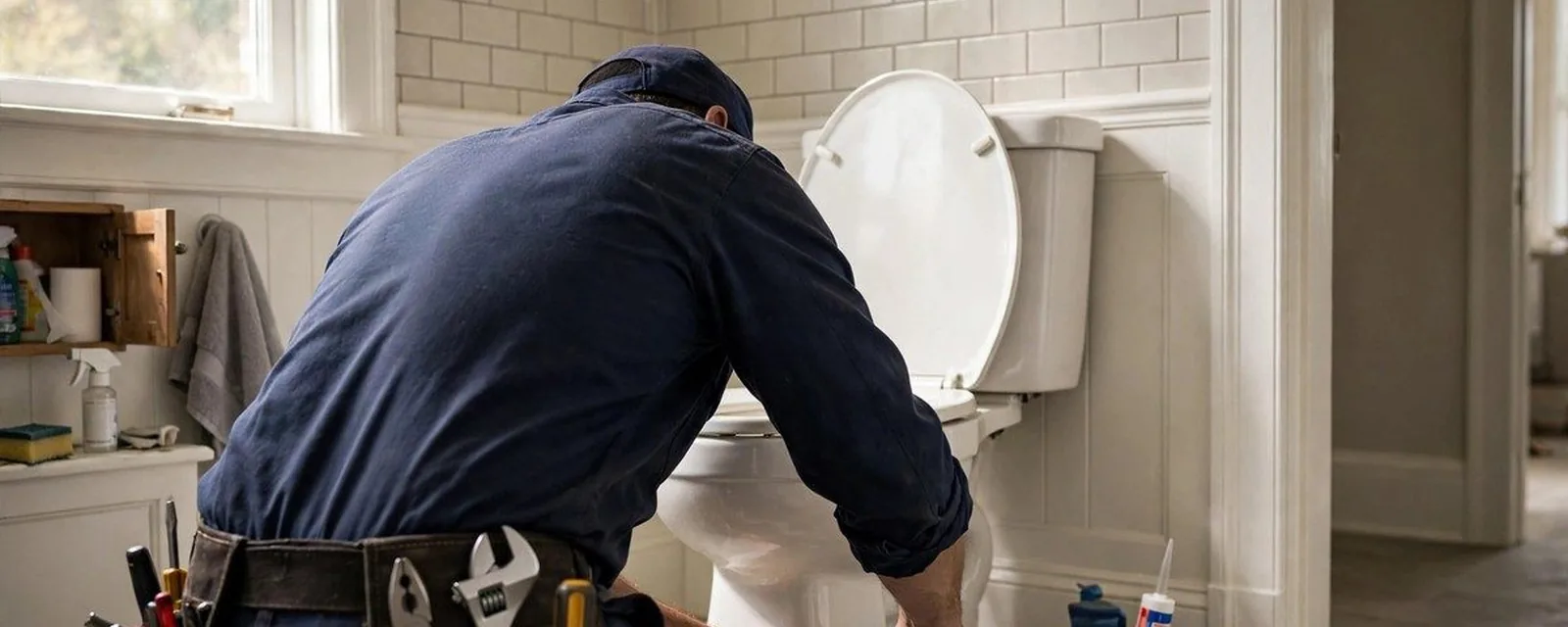
First, stop the overflow
Before you try to clear anything, take the lid off the tank and push the flapper down to stop water entering the bowl. Or close the supply valve behind the toilet by turning it clockwise. Do not flush again hoping it will go.
If the bowl is nearly full, scoop some water out with a cup into a bucket. A bowl at a safer level lets you work without a spill.
Methods that work without a plunger
Hot water and dish soap
Squirt a generous amount of dish soap into the bowl and let it sit for a few minutes. Then pour hot water, not boiling, from about waist height. The soap lubricates the clog and the water adds weight. Boiling water can crack porcelain, so use water that is hot from the tap or warmed on the stove.
Baking soda and vinegar
Pour in a cup of baking soda and then a cup of vinegar. The fizz is gentle and rarely moves a firm clog, but it can loosen soft paper. Give it half an hour before trying again.
A wire hanger or a bottle
A straightened hanger wrapped in cloth can push or pull a clog near the trap. Be careful not to scratch the porcelain. A plastic bottle with a narrow spout used like a pump creates pressure that mimics a plunger, though it is messy.
| Method | Works best on | Skip if |
|---|---|---|
| Dish soap and hot water | Paper or soft waste | The bowl is full of water |
| Baking soda and vinegar | Light, soft clogs | A firm blockage is likely |
| Wrapped wire hanger | A clog just past the trap | Porcelain scratches are a concern |
| Bottle method | Mid-level clogs | You do not want a mess |
Toilet still blocked? Call the 24/7 line.
Call (650) 860-1670What not to do
- Do not pour chemical drain cleaners into a full toilet. They can sit in the bowl, damage the finish and splash caustic liquid on the plumber later.
- Do not flush repeatedly. Each flush adds water and can overflow the bowl.
- Do not use boiling water. It can crack the bowl.
- Do not push a hard object down the drain without knowing what is there. You can lodge a clog deeper.
When it is not just the toilet
A single toilet that clogs once is a toilet problem. If the tub gurgles or fills when you flush, or other drains are slow, the blockage is further along in the branch or the main line. That is a sewer line cleaning job, and trying to fix it at the bowl will not work.
Repeated clogs in one toilet point to a different problem, such as a partial blockage in the trap, a misaligned flange or an old low-flow unit that does not move waste well. Toilet repair covers those causes and the choice between fixing and replacing.
Why toilets clog in the first place
Most clogs come from too much paper at once, flushed wipes or a small object in the trap. A modern low-flow toilet moves waste with less water, which leaves little margin when something bulky goes down. An older toilet with weak rim jets can also struggle even with ordinary use.
Products labeled flushable are a frequent cause. They do not break up the way toilet paper does and can catch on roots, rough pipe joints or each other farther down the line. Treat wipes of any kind as trash.
Keeping the next clog away
- Keep a plunger in the bathroom. A flange plunger works best on a toilet.
- Flush paper in smaller amounts, and flush twice if you must use more.
- Put a small covered bin in every bathroom for anything that is not toilet paper.
- Check children's toys and brushes. A small object in the trap is a classic cause.
- Watch for a slow flush that gets slower. It often comes before a full blockage.
If a toilet keeps clogging with normal use, the toilet or the drain behind it has a fault that a plunger will not cure.
A word on toilet augers
A closet auger, sometimes called a toilet snake, is a short cable in a rigid sleeve that fits a toilet drain without scratching porcelain. It is inexpensive and reaches a clog a plunger cannot. If you plan to keep a tool in the bathroom, an auger earns its place beside the plunger.
Who handles what in Mountain View
The City of Mountain View's water and sewer FAQ says property owners are responsible for clearing blockages in the home plumbing and the lateral that connects to the City's sewer main, and that the City clears its own mains. If several fixtures in your house back up together, the cause is more likely the lateral than the toilet.
If neighbors report the same problem, or you see sewage at a street manhole, tell Public Works as well. For homes across the border in Los Altos, the City of Los Altos draws the line at the first joint after the property line, so the contact is different.
Our service area covers Mountain View and the nearby towns if the clog turns out to be beyond a household fix.
A toilet that keeps clogging may have a flange or trap set wrongly for the California Plumbing Code, which a plumber can check in a few minutes.
Questions about this topic
Is dish soap safe for a clogged toilet?
Yes. It is a common household method and does not harm the porcelain or pipes.
Can I use a chemical drain cleaner on a toilet?
We do not recommend it. If it fails, the bowl holds caustic liquid, and the plumber has to work around it.
Why does my toilet clog so often?
Possible causes include a partial blockage in the trap, a poorly seated flange, a weak flush or too much paper. A plumber can find which.
When should I call a plumber for a clogged toilet?
When the methods above fail, when other fixtures also back up or when the toilet overflows with each flush.
Who is responsible for a blocked sewer lateral in Mountain View?
According to the City's FAQ, the property owner clears blockages in the home plumbing and lateral, and the City clears its own mains.