
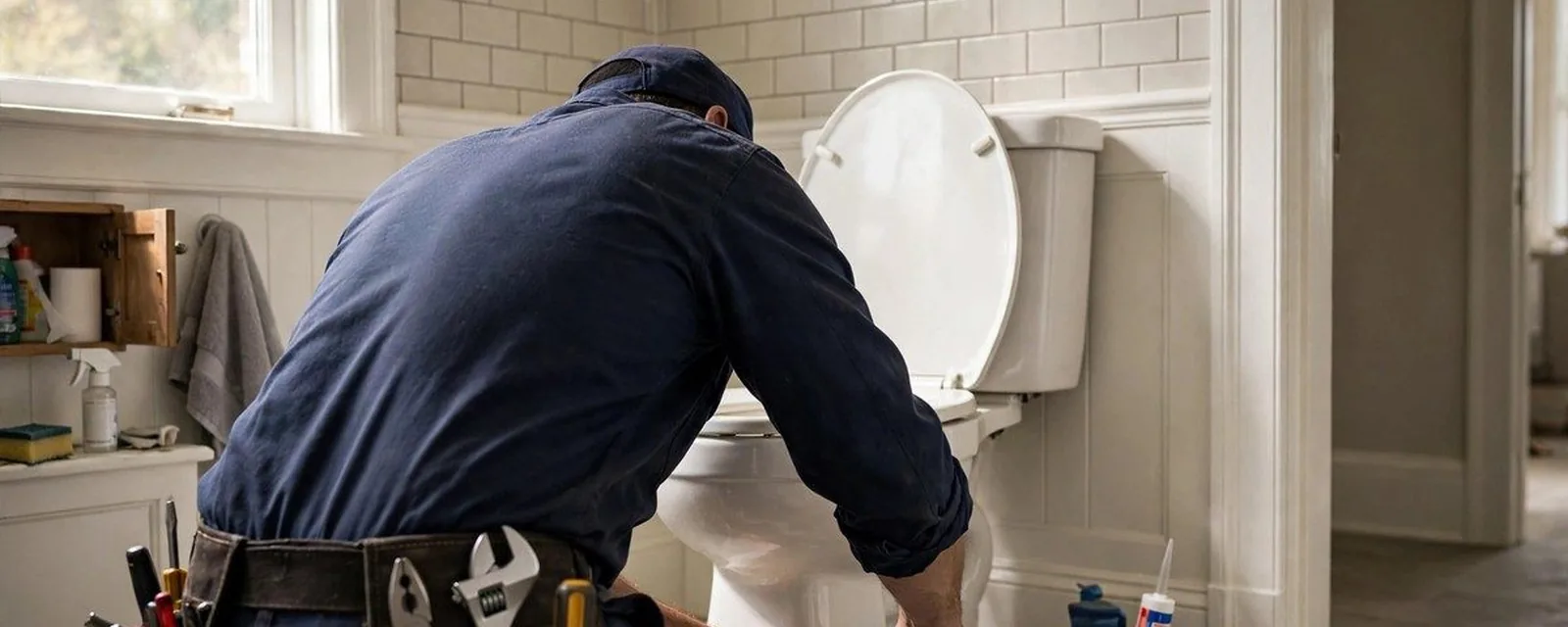
If the toilet is overflowing
Reach behind the toilet and close the valve on the supply line by turning it clockwise. Lift the tank lid and push the flapper down, or lift the float, to stop water entering the bowl. Do not flush again.
If other fixtures are also backing up, the blockage is further down the line. See sewer line cleaning. Wipe up standing water promptly and keep children away from it.
Common toilet problems and fixes
| Symptom | Likely cause | Fix |
|---|---|---|
| Overflows when flushed | Clog in the trap or drain | Plunge or auger |
| Runs constantly | Worn flapper or fill valve | Replace parts |
| Weak flush | Clogged rim jets or low tank water | Clean, adjust |
| Water at the base | Failed wax ring or loose bolts | Reset the toilet with a new seal |
| Rocks on the floor | Loose flange or bolts | Reset or repair the flange |
| Cracked bowl or tank | Damage | Replace |
Repair or replace
Most toilet issues are repairable for a modest cost. Replacement makes sense when the porcelain is cracked, when parts are no longer available or when an old high-flow unit wastes water. A new toilet uses far less water per flush than one made decades ago.
- Diagnose. The plumber finds whether the issue is the tank parts, the seal or the drain.
- Quote. You get a price for repair and for replacement when both are realistic.
- Work. The toilet is cleared, repaired or replaced, and the base is sealed and tested.
- Clean up. The plumber wipes the area and takes away any old parts.
Toilet overflowing? Call the 24/7 line.
Call (650) 860-1670What affects the price of toilet work
- The fault. A flapper is a quick fix. A reset with a new seal takes longer.
- Clearing versus repairing. A clog is a different job from a leak.
- Replacement toilet. The model you pick drives the cost.
- Flange or floor damage. A rotted subfloor or broken flange adds repair.
- Time of call. After-hours dispatch costs more.
Replacement includes the old toilet's removal. If the toilet has been leaking for a while, check the floor for soft spots. The plumber gives you the price before starting.
Installing a new toilet: what the plumber does
- Shut off and drain. The supply is closed and the tank and bowl are emptied.
- Remove the old toilet. The bolts are cut or unscrewed and the toilet lifted off the flange.
- Check the flange and floor. A cracked flange or soft floor is repaired before the new toilet goes on.
- Set the new toilet. A new wax or foam seal is placed, the bowl is set level and bolted down evenly.
- Connect and test. The supply line is connected and the toilet is flushed several times while checking for leaks.
Tightening the bolts too hard can crack the porcelain, and too little leaves the seal loose. The feel of the right torque comes from having done it many times.
Choosing a replacement toilet
Rough-in distance, the gap from the wall to the center of the drain, decides which models fit. Most are twelve inches, but older homes can differ. Bowl shape matters too. Elongated bowls are more comfortable and need more room, while round bowls suit tight spaces.
Look at flush performance, not just the gallons per flush on the label. A toilet that needs two flushes saves nothing. Ask the plumber which models they see fewest callbacks on.
Fixture rules tied to permits
The City of Mountain View's Building Division notes that California Civil Code sections 1101.1 to 1101.8 require water-conserving plumbing fixtures. For single-family alterations with a permit, the applicant must replace noncompliant fixtures and return a signed flow rate certificate before the final inspection. If your toilet replacement is part of a permitted remodel, ask your contractor about that certificate.
Toilets and their flanges are covered by the California Plumbing Code, and the water-conserving fixture rules the City cites come from California Civil Code sections 1101.1 to 1101.8.
Toilet Repair questions
Is emergency toilet repair available at night in Mountain View?
Yes. Call (650) 860-1670 at any hour. Close the supply valve at the wall and a licensed plumber is dispatched.
Why does my toilet keep running?
A worn flapper or fill valve is the usual cause. The part is inexpensive, but running water raises your bill, so fix it.
Is it worth repairing an old toilet?
Often yes for a simple part. Replace it if the bowl is cracked, the flange is damaged or you want to cut water use.
Can I replace a toilet myself?
You can, but the seal and flange have to be right or you risk floor damage. A plumber does it with a new seal and tests for leaks.
Why does water seep around the base?
The wax ring has likely failed or the toilet is loose. Do not keep using it, because the subfloor can rot.