
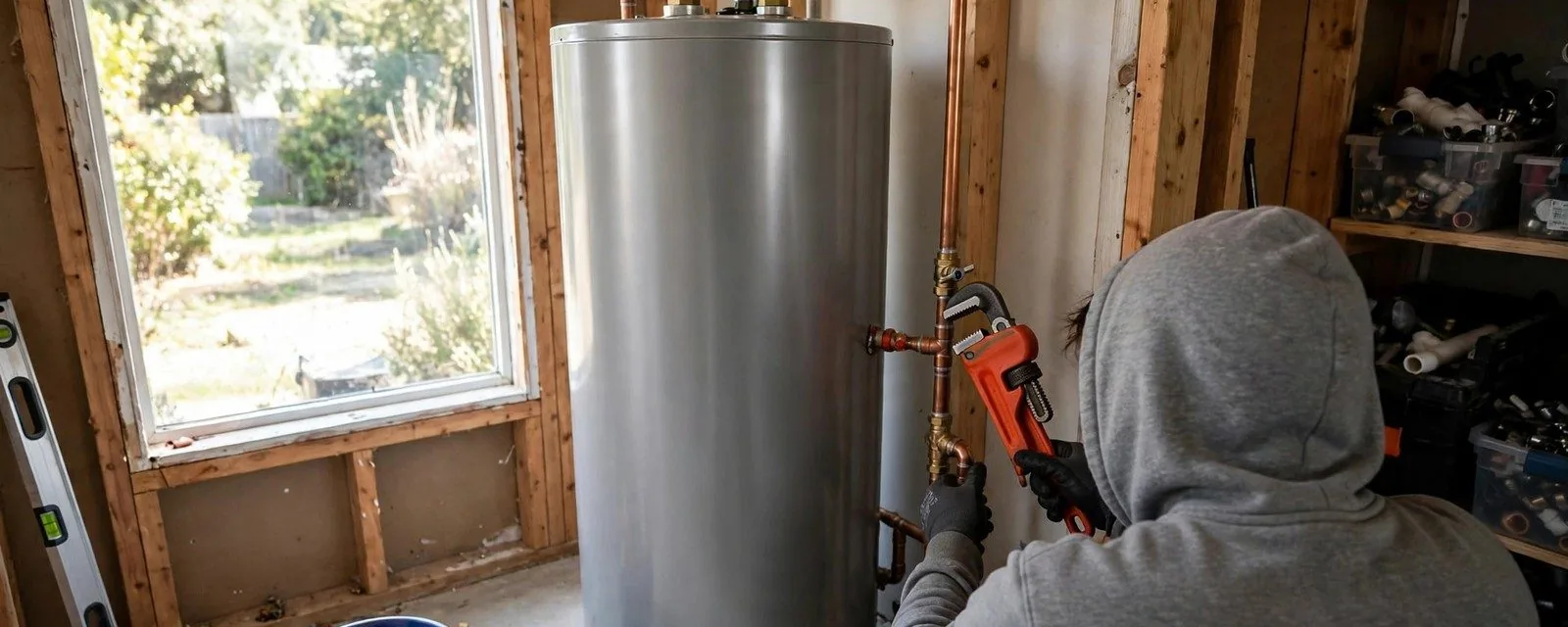
Before the install day
- Site visit. The plumber looks at the existing heater, the gas meter and line, the likely vent route and the nearest drain and power.
- Written quote. It lists the unit, any gas line upsizing, venting, condensate drain, isolation valves, the permit and haul-away.
- Permit. The Building Division requires one for every water heater installation, to be pulled before work starts.
- Order and schedule. The unit is ordered, and a day is booked that covers the hours without hot water.
Ask how long the water will be off. A tank swap takes a few hours. A tankless conversion often takes longer because of the gas and vent work.
On the day
Shut down and remove
The plumber shuts off gas or power and cold water, then drains the old tank. The tank is disconnected and carried out. If you are converting from a tank, the old gas flue and relief piping are removed or capped.
Mount and connect
The unit is mounted on the wall with the clearances the manufacturer requires. Water lines, isolation valves and the gas connection are made. Isolation valves matter because they let a plumber flush the unit later without cutting pipe.
Vent and drain
The vent is run and sealed. Condensing models get a drain line for acidic condensate, often with a neutralizer. The plumber checks that the condensate drains away from the unit.
Test and set
Gas is tested for leaks, the unit is fired and temperature and flow are checked at several taps. The plumber sets the temperature and shows you the controls and error codes.
Ready to schedule a tankless install? Call for a site visit.
Call (650) 860-1670| Factor | Effect | Where it shows up |
|---|---|---|
| Gas line too small | Upsize the line | Quote and schedule |
| Hard vent route | More cutting and sealing | Quote and schedule |
| No nearby drain for condensate | New drain run | Quote |
| Old shutoffs that will not hold | Replace valves | Day of install |
| Recirculation line wanted | Extra plumbing and a pump | Quote |
Inspection and handover
After the work, the City inspector checks the installation. In practice the plumber arranges the inspection and tells you the window. You should end the day with the unit running, the permit number, the manual, the warranty details and a note on when to flush.
Keep those documents. A future buyer or an insurer may ask for them, and the flush interval in the manual is the one the warranty assumes.
Costs that are easy to miss
A quote that lists only the unit and labor can hide the real total. Ask whether it covers gas line changes, venting, the condensate drain, isolation valves, the permit and the old tank's removal.
If you want to understand what drives the price in more detail, the tankless water heater page lists the main cost factors, and water heater installation covers the tank alternative for comparison.
Gas supply: the question that surprises people
A tank heater and a tankless heater can both be gas, but they draw very different amounts. A tank burner is modest and runs for a while. A tankless burner is large and runs at once when a tap opens. The gas line that served the tank is often too small for it.
The plumber checks the pipe size, its length from the meter and what else it feeds, such as a furnace or a range. If the line is short on capacity, the choices are upsizing the line or choosing a smaller unit. Your gas utility controls the meter, so any change at the meter is its decision, not the plumber's.
If you smell gas at any time, leave the building and call the gas utility or 911 from outside. Do not turn lights or appliances on or off on your way out.
What to prepare at home before the crew arrives
- Clear a path from the front door to the old heater and the new location.
- Move stored items away from the work area, including shelves on the heater wall.
- Turn off any appliance that depends on the heater for the day, such as a recirculation pump.
- Plan for no hot water during the work. Fill a kettle if you need it.
- Have the permit documents, previous heater paperwork and warranty cards in one place.
Tell the crew about pets, children and anyone who needs the bathroom during the work. Small details like these make the day shorter.
After the install: the first month
Watch the unit for the first few weeks. Note any error codes, temperature swings or noises, and report them while the installer is still fresh on the job. Check around the unit and the vent for moisture, and confirm the condensate drain is running clear.
Register the warranty if the maker requires it, and put the first flush date on your calendar. A unit that is looked after in its first year tends to stay trouble-free.
What the City of Mountain View asks of an install
The Building Division at 500 Castro Street, reachable at 650-903-6313 or building@mountainview.gov, states that a permit is required for every water heater installation and replacement and must be obtained before work begins. Its guide also calls for two seismic straps on a tank heater. For a wall-mounted tankless unit, ask the Division what mounting and bracing it expects, since the strapping rule was written for tanks.
If your home is in Los Altos, the permit comes from the City of Los Altos instead, so confirm the right office for your address.
Not sure which office issues the permit for your street? Check the service area page for the towns we cover, then confirm with the right building department.
The inspector checks the finished install against the California Plumbing Code, so keep the permit card and the manual together for the visit.
Questions about this topic
How long does a tankless installation take in Mountain View?
Often a day, longer if the gas line or vent route needs real work. The plumber gives you a schedule with the quote.
Who pulls the permit?
The installing plumber usually does. Confirm it is in the quote and ask for the permit number afterward.
Do I need to be home?
An adult should be present at the start and at the end to approve the work and learn the controls.
What if the city inspector finds a problem?
The plumber corrects it and the inspection is repeated. Ask whether re-inspection is included.
Will my water be off all day?
Not usually. Water is off while the old unit is removed and the new one connected, and back on for testing.