
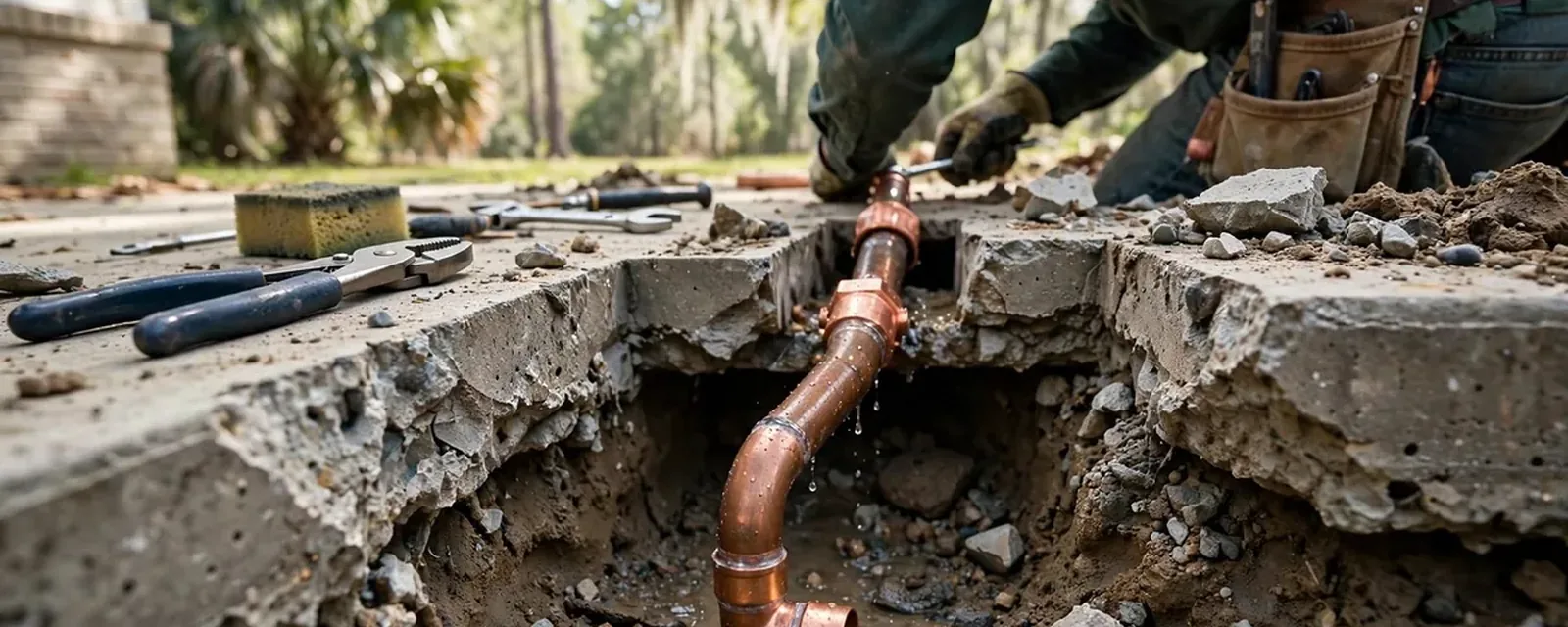
Signs of a slab leak and what to do first
Warm or hot spots on a floor, the sound of running water when everything is off, wet carpet or damp baseboards along a wall and a musty smell are all signs. So are a meter that moves with all fixtures closed and a water bill that rises without explanation.
Turn off the main valve if you suspect a leak under the floor. If the meter stops, the leak is on the house side. Water under a slab can lift flooring, stain walls and undermine soil, so treat the call as urgent.
How the leak is confirmed
- Meter and valve test. The plumber confirms water is moving when it should not be and narrows the leak to the house side.
- Isolation. Sections of the supply are closed to find which line is losing pressure.
- Electronic location. Acoustic listening devices and thermal imaging find the point on the slab surface.
- Mark and explain. The location is marked, and you see the options before anyone cuts concrete.
Leak detection is the first step for any hidden water problem. A slab leak is what it turns out to be when the water line sits in the floor.
Three ways to fix a slab leak
Spot repair through the slab
The plumber breaks a small opening in the floor over the leak, repairs the pipe and patches the concrete. This suits a single failure where the surrounding pipe is sound.
Reroute the line
A new line is run through walls or attic space and the old section under the slab is abandoned. This avoids breaking concrete and is useful when the old pipe has failed in several places or the leak is under a hard-to-access area.
Repipe
If the pipe is failing everywhere, a full repipe replaces the supply system. It costs the most up front and removes the repeating risk.
Suspect a leak under the floor? Call and shut the main.
Call (650) 860-1670| Option | Best when | Trade-off |
|---|---|---|
| Spot repair | One leak, sound pipe elsewhere | Breaks a small area of floor |
| Reroute | Multiple leaks or hard-to-reach location | New pipe in walls or attic |
| Repipe | Pipe failing throughout | Highest cost, lasting fix |
What affects slab leak repair cost
- Leak location. A leak under an open hallway is simpler than one under a kitchen cabinet.
- Floor finish. Tile, wood and carpet each need different repair after the dig.
- Method. Spot repair, reroute and repipe price very differently.
- Pipe material. Copper and PEX routes use different parts.
- Water damage. Drying and floor repair are separate from the plumbing work.
Insurance may cover the cost of access and the resulting damage in some policies and not the pipe repair. Ask before work. The plumber gives you the options with prices before any concrete is cut.
Mid-century slab homes in Mountain View
The City's historic context statement dates the Fairview Eichlers in Monta Loma to roughly 1954 to 1957. Homes of that era are often slab-on-grade, and some Eichlers have heating pipe in the floor in addition to supply lines. A warm patch on a floor in one of these houses can be hot-water supply or a heating loop, and finding out which is part of the diagnosis.
Blossom Valley's 1950s and 1960s ranch homes may have slabs too. If your house was built in those decades, mention the year when you call.
Rerouted or replaced supply lines are installed to the California Plumbing Code, Part 5 of Title 24, and the City decides whether a permit and inspection apply to your address.
Slab Leak Repair questions
Is emergency slab leak repair available at night in Mountain View?
Yes. Call (650) 860-1670 at any hour. Shut off the main valve and a licensed plumber is dispatched to confirm and locate the leak.
How do you find a leak under concrete?
By testing pressure, listening with acoustic equipment and scanning for heat. The location is marked on the slab before any cutting.
Do I have to break the whole floor?
No. Spot repair opens a small area, and rerouting avoids the slab altogether.
Can a slab leak damage my foundation?
Persistent water under a slab can undermine soil and lift flooring. That is why it should be fixed promptly.
Is rerouting better than repairing?
It depends. Rerouting avoids concrete work and handles several failures. Spot repair is simpler for a single leak.