
Four questions that decide it
- Is the tank leaking? A leak from the tank body means replacement. It cannot be patched.
- How old is the unit? The age is on the label and in the serial number.
- What failed? A simple part is not the same as a failed tank or a failed heat exchanger.
- What does the repair cost against a new unit?
If the answer to the first is yes, stop. Close the cold supply, cut power or gas and call. The decision is made.
A decision table
| Situation | Usually | Why |
|---|---|---|
| Leak from the tank body | Replace | The steel has failed |
| Old unit, major part failed | Replace | Repair cost approaches a new unit |
| Newer unit, thermostat or element fault | Repair | Small part, long life left |
| Pilot or thermocouple fault | Repair | Inexpensive part |
| Rust-colored hot water, old tank | Replace soon | Tank corroding inside |
| Frequent repairs in a short time | Replace | The pattern is the signal |
Heater failed? Call for an honest repair or replace answer.
Call (650) 860-1670What a repair visit can tell you
A plumber diagnosing the heater should tell you what failed, what a repair costs and whether the unit has useful life left. Ask to hear both numbers. A visit that ends with only a replacement quote and no repair option leaves you without the information.
See water heater repair for the common faults and water heater replacement for how the swap works.
If you replace
Replacing is a chance to rethink size and type. A like-for-like tank is fastest and cheapest. A larger tank helps a household that runs out. A tankless unit saves space and runs endlessly, though it needs gas and venting that may add cost. Heat pump models are another option where space and drainage allow.
If time allows, compare options. If the old unit is flooding the garage, take the quick like-for-like swap and plan an upgrade later. Water heater installation covers planned work.
Reading the age of your heater
The label on the tank carries a serial number. Most makers encode the manufacture date in it, often as a letter for the month and digits for the year. A plumber can decode yours in seconds, or you can look up the maker's key online. Knowing the age turns a vague worry into a number.
As a rule of thumb, a tank heater in its second decade is living on borrowed time. That does not mean it must be replaced the day it turns ten. It means a failed part on an old unit is a weaker case for repair than the same part on a newer one.
Signs that a heater is nearing the end
- Rusty or brownish hot water, but clear cold water.
- Rumbling, popping or knocking from the tank as sediment bakes on the bottom.
- Moisture or rust around the base or fittings.
- Hot water that runs out faster than it used to.
- A relief valve that drips repeatedly.
Any one of these is worth a look. Several together are a strong argument for planning a replacement before the tank fails.
Anode rods and flushing: extending the life
A tank has a sacrificial anode rod that corrodes in place of the steel. Checking and replacing it can extend a tank's life if done before the rod is gone. Flushing sediment from the tank bottom reduces noise and keeps the burner or elements working efficiently.
Neither is a cure for a tank that has already rusted through. If you plan to keep an older heater, ask a plumber to inspect it first.
Putting numbers on the decision
Ask for two written prices, one for the repair and one for a like-for-like replacement including the permit and straps. Compare them with the age of the unit. A repair that costs a small share of a replacement on a newer heater is an easy yes. A repair that costs most of a replacement on an old heater is a no.
Remember what a repair does not buy. It fixes the part that failed and leaves every other part as old as before. Replacement resets the clock on the whole unit and usually carries a fresh warranty. Ask what the warranty covers and for how long.
If you plan to sell the house within a few years, a working newer heater is one less item on an inspector's report. If you plan to stay a long time, replacement is more likely to pay off.
What to do when the tank leaks
If the tank is leaking, make the decision quickly, since delay turns a small leak into a flood. Shut off the supply, cut the power or gas and call. We can usually tell you on the phone what is possible the same day.
The permit and the straps
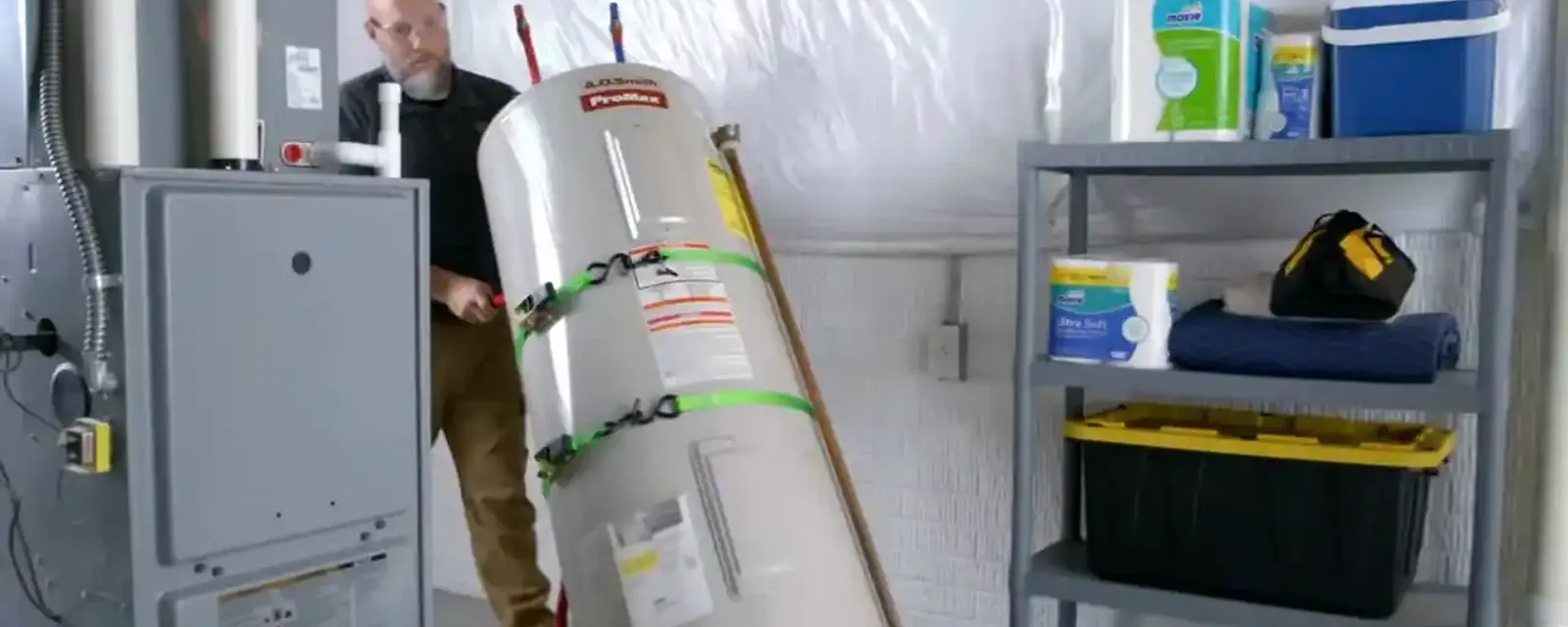
The City of Mountain View's Building Division at 500 Castro Street requires a permit for every water heater installation and replacement. The permit must be obtained before work starts. The City's guide asks for two seismic straps, one in the top third and one in the bottom third of the tank.
A plumber who says no permit is needed for a swap is giving advice that does not match the City's guidance. Call 650-903-6313 if you want to hear it from the Division. In Los Altos, the City of Los Altos issues the permit.
The service area page lists the towns where we can replace a failed tank on short notice.
A replacement heater is installed to the California Plumbing Code, Part 5 of Title 24, which the state lists in its 2025 edition as effective January 1, 2026.
Questions about this topic
How long does a water heater last?
It varies with the unit and your water. Many tank heaters last around a decade or somewhat more. The label and serial number date yours.
Can a leaking water heater be repaired?
Not if the leak is from the tank body. A leak from a valve or fitting may be repairable.
Do I need a permit to replace a water heater in Mountain View?
Yes. The City requires a permit for every water heater installation and replacement.
Should I upgrade to tankless when I replace?
Only if the gas line and venting suit it. Many owners replace the tank now and upgrade later.
Will my insurance pay for a new water heater?
Usually not for the heater itself, though it may cover resulting water damage.