
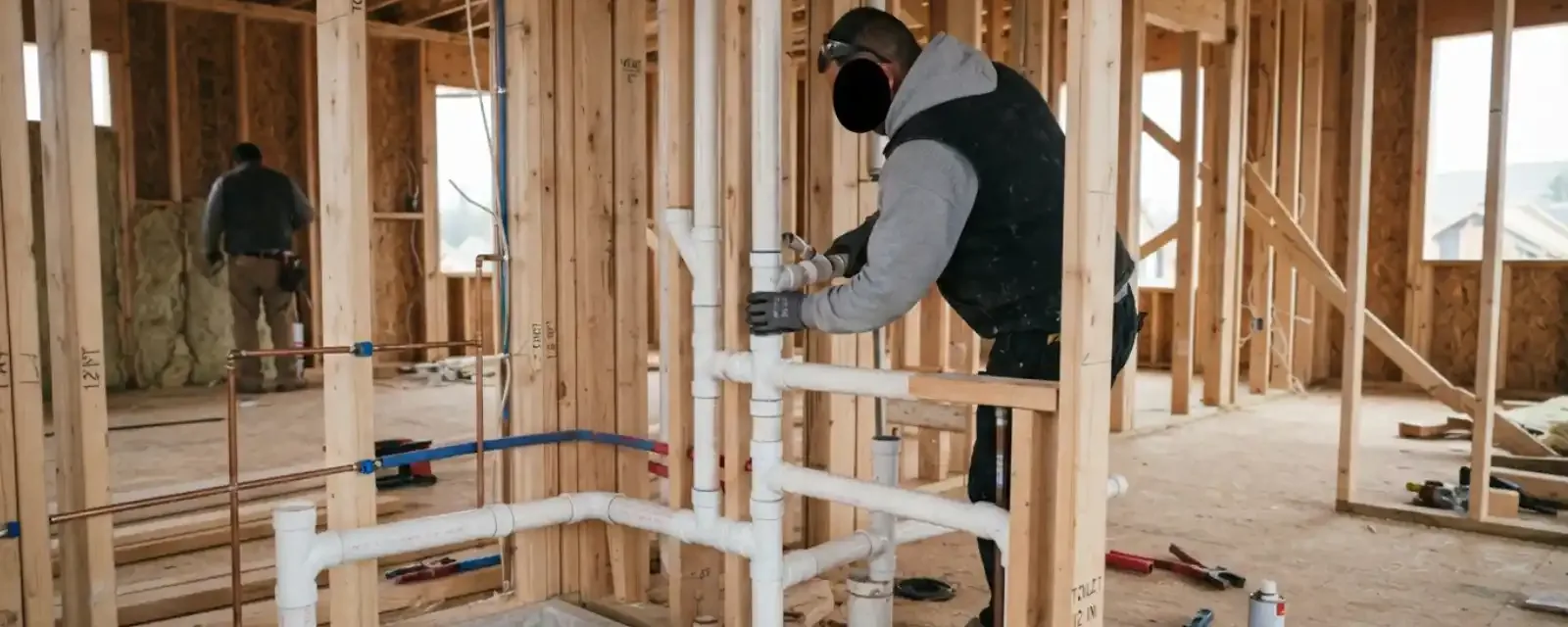
How the fittings work
Inside the fitting is a stainless steel grab ring with teeth that bite into the pipe, and an O-ring seal that presses against the pipe wall. When you push the pipe past the seal to the stop, the ring grips and the seal closes. A release tool or collar lets you remove the fitting later.
The pipe has to be cut square, deburred and clean, and pushed in to the full depth mark. Most failed push fittings trace to an unclean cut or a pipe not pushed all the way in.
Where they help
- Emergency repairs when you need to stop a leak and have no torch.
- Tight spaces where flame is a fire risk, such as near framing or insulation.
- Repairs on a line that cannot be fully drained, since soldering needs a dry pipe.
- Transitions between different pipe types when the fitting is rated for both.
Many professionals carry them for exactly those reasons. They are a tool, and a good plumber chooses between them and soldered or crimped joints based on the job.
Pipe leaking and unsure how to fix it? Call the 24/7 line.
Call (650) 860-1670| Method | Strength | Limit |
|---|---|---|
| Push-to-connect | Fast, no torch | Needs a clean, square pipe end and rated use |
| Soldered copper | Long-standing, permanent | Needs a dry pipe and flame |
| Crimped or expansion PEX | Common for new work | Needs the right tool and pipe |
| Threaded steel | Used on gas and older water lines | Needs thread sealant and care |
Limits to know
Check the fitting's rating for the pipe type, the pressure and the temperature of your line. A fitting rated for cold water may not be the right choice on a hot line in the same size. Fittings are also meant to be accessible in many installations, so burying one inside a wall without access may not be allowed.
Never assume a fitting is acceptable everywhere just because it works. The plumbing code the City enforces decides what is permitted for a given use, and an inspector can reject a joint that does not meet it. For a permanent repair in a wall, ask a plumber.
A short checklist for using one
- Shut off water and open a tap to drain the line.
- Cut the pipe square and remove burrs inside and out.
- Mark the insertion depth on the pipe.
- Push the pipe in fully to the mark and tug to confirm.
- Turn the water on slowly and watch the joint for several minutes.
If any step feels uncertain, treat the repair as temporary and call a licensed plumber. See burst pipe repair for a lasting fix.
Reading the markings before you trust a fitting
A fitting body carries information on its surface or its packaging. Look for the pipe types and sizes it accepts, the maximum pressure and temperature, and the standards it has been tested to. If the markings are missing or unreadable, do not install it.
Match the fitting to the pipe exactly. A fitting made for copper may not be rated for plastic pipe of the same outside diameter, and the reverse is also true. If you are joining two different materials, confirm that the fitting is rated for both.
Mistakes that cause leaks
- Cutting the pipe at an angle instead of square.
- Leaving burrs or a rough edge that cuts the O-ring.
- Not pushing the pipe to the full depth mark.
- Using a fitting on a pipe that is scratched or out of round.
- Reusing a fitting that was removed without checking the ring and seal.
A fitting that leaks after the water is back on is almost always a preparation fault. Turn the water off, take it apart, check the pipe end and try again with a clean cut. If it fails twice, stop and call a plumber.
When a push fitting is the wrong tool
- On a line where the pipe is corroded or pitted at the joint, since the seal needs a smooth surface.
- Where the fitting would be hidden in a wall with no access, unless the rules for your job allow it.
- On gas lines, which need fittings rated and approved for gas.
- On a line you cannot fully drain and dry for a clean insertion.
- In an application the fitting's markings do not list.
A push fitting can be an excellent emergency measure and a poor permanent one. Treat it as a bridge to a proper repair when you are not sure.
Tools that make push fittings reliable
A proper tubing cutter makes a square cut, which a saw rarely does. A deburring tool removes the sharp edge inside and out. A depth gauge or a marker shows when the pipe is fully seated. These three small tools cost little and prevent most failures.
Permits and who decides what is allowed
The City of Mountain View's Building Division enforces the plumbing code for permitted work, and its inspectors decide what passes. The City's published pages we reviewed do not list approved fittings, so call the Division at 650-903-6313 or email building@mountainview.gov before you plan a permanent repair that needs a permit.
The Contractors State License Board lists a C-36 classification for plumbing contractors. For anything beyond a minor repair, hire a licensed plumber and ask for the license number. The same advice applies in Los Altos, where the City of Los Altos is the office that issues permits.
Find the towns we reach on the service area page if you want a licensed plumber to make the repair permanent.
Which fittings are acceptable in a given use is a California Plumbing Code question, so check the code or ask the Building Division before a permanent repair that needs inspection.
Questions about this topic
Are push-to-connect fittings reliable?
They can be when used within their rating and installed correctly, with a clean square cut and full insertion. Most failures come from poor preparation.
Can I use them inside a wall?
Check the fitting's rating and the local rules. Many installers prefer accessible locations, and an inspector decides on permitted work.
Do push fittings work on hot water lines?
Only if the fitting is rated for hot water at that size. Read the markings and the package.
Can I remove a push fitting?
Yes, with the release tool or collar the manufacturer specifies. Do not pull on it.
Who can I ask about what Mountain View allows?
The Building Division at 650-903-6313. We do not assume an answer for your address.