
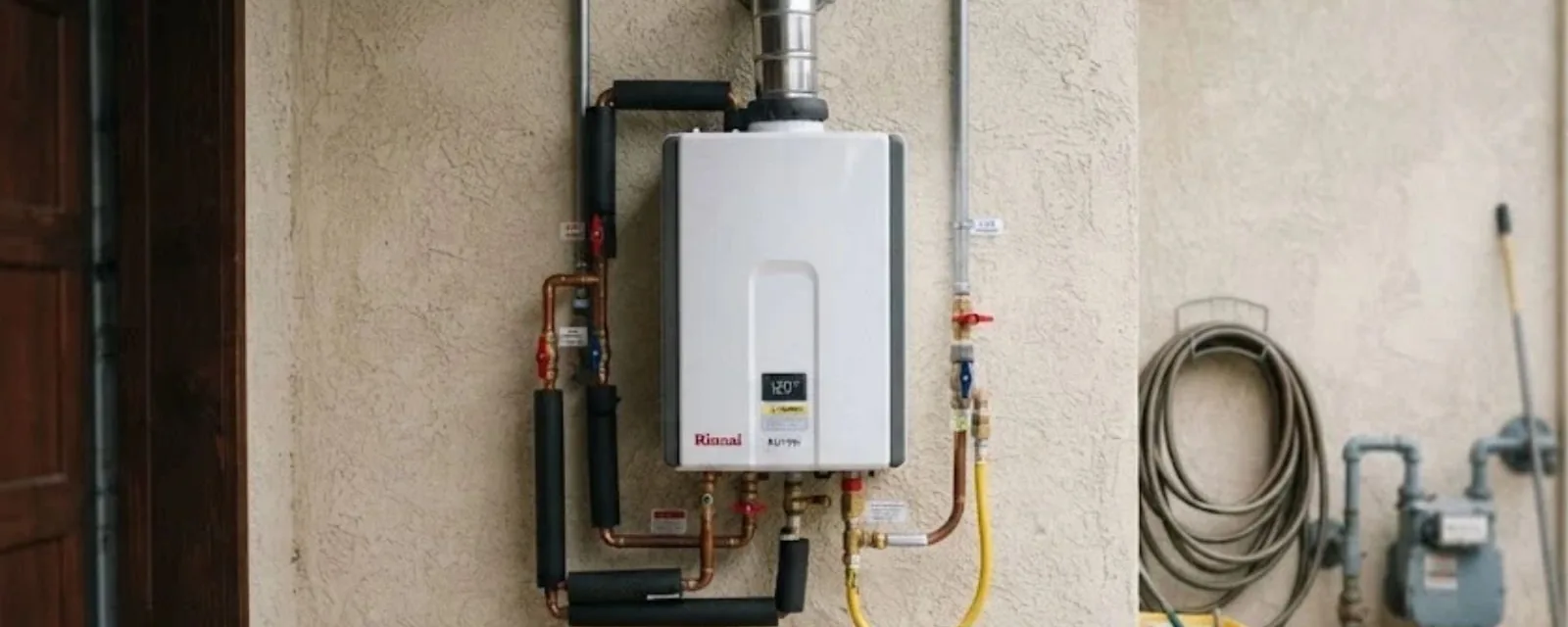
Start with one test
Open a hot tap fully, then a cold tap at the same fixture. Compare them. Check other fixtures too. A problem at one fixture is a local problem. A problem everywhere on hot only points to the heater or the hot lines.
| Pattern | Likely cause | Next step |
|---|---|---|
| Hot weak everywhere, cold strong | Heater scale, clogged inlet screen or partly closed valve | Check valves, flush the unit |
| Both weak everywhere | Supply pressure or partly closed main | Check the main valve and pressure |
| Weak at one fixture | Aerator or cartridge | Clean or replace |
| Hot weak after the heater was serviced | Isolation valve not fully open | Open the valves |
Common causes on the heater
Scale in the heat exchanger
Minerals build up inside the exchanger and restrict flow. A descaling flush restores it. The manual gives the interval, and heavy scale often shows up as error codes too.
A clogged inlet screen
Many units have a small screen where water enters. Sediment can clog it. It can usually be removed and rinsed.
Isolation valves not fully open
After service, valves left half open choke flow. Check that the handles line up with the pipe.
A flow limit built into the unit
Some units reduce flow to reach the set temperature at high demand. Lowering the setpoint raises flow, which is why a lower temperature can feel stronger.
Hot water weak and the cause is unclear? Call for a plumber.
Call (650) 860-1670Causes outside the heater
- Corroded or scaled hot water pipes, particularly in older homes.
- A pressure regulator that is failing or set low.
- A partially closed main or branch valve.
- A leak somewhere in the hot line, which the leak detection page covers.
If hot pipes are corroded, no heater service will cure the flow. That is a repiping discussion.
What a plumber checks
- Measure pressure. A gauge on a hose bib shows static pressure into the house.
- Check flow at the heater. Gallons per minute through the unit show whether the unit or the pipes are the limit.
- Inspect screens and valves. Sediment and half-open valves are common.
- Flush and test. A flush restores the exchanger, and a retest confirms the fix.
Tankless water heater service explains flushing and repair in more detail.
Flushing a tankless unit step by step
- Power down. Turn off the unit and close the gas and water supply.
- Connect hoses. Attach hoses to the service ports on the isolation valves, one to a pump and bucket, one back into the bucket.
- Circulate descaler. Run a descaling solution through the heat exchanger for the time the manual states.
- Rinse. Flush with clean water until it runs clear.
- Restore and test. Reopen the valves, power up and check flow and temperature.
A flush needs isolation valves with service ports. If your unit lacks them, a plumber can add them so the job is simple next time.
Checking the inlet screen
Most units have a small filter screen where cold water enters. It catches sediment before it reaches the heat exchanger. Turn off the water, unscrew the inlet fitting and slide the screen out. Rinse it under a tap. A screen packed with grit can cut flow noticeably, and cleaning it costs nothing.
If you find a lot of debris, the supply line or the main may be shedding sediment. A whole-house sediment filter is worth discussing with a plumber.
When pipes, not the heater, are the problem
Old galvanized or corroded copper pipes narrow from the inside. Hot lines can be affected more than cold because heat speeds corrosion and scale. If the heater is clean and flow is still weak at several fixtures, the pipes are the likely cause. That is a diagnosis for a plumber with a flow gauge.
Setting the temperature to help flow
A tankless unit raises water temperature by a fixed amount at a given flow. The higher the setpoint, the less flow it can heat. If your unit is set to a very high temperature, it may cut flow at a busy tap to hit the target. Lowering the setpoint a little can raise flow without a big change in comfort.
Check the water temperature at your tap with a thermometer. Many households set the heater higher than they need and then mix with cold at the faucet, which wastes capacity. A lower setpoint also reduces scald risk for children and older adults.
Safety notes while you troubleshoot
Turn off gas and power before opening any panel or disconnecting a fitting. Do not remove a vent or alter the gas connection yourself. If you smell gas, leave the building and call the gas utility or 911 from outside.
Tankless units run hot enough to scald. When you test flow at the tap, use a thermometer and keep children away from the tap. If you are not comfortable with a step, stop and call a plumber.
Mountain View supply pressure
The City of Mountain View's water FAQ says the system delivers an average minimum pressure of 45 pounds, above the state requirement of 25 pounds. That is the pressure on the City side. What reaches your tap depends on your plumbing, the pressure regulator if you have one and the condition of your pipes.
If both hot and cold are weak, ask a plumber to measure pressure at a hose bib. The same applies in Los Altos, where your water provider's pressure may differ.
For a flow test on your unit, the service area page shows whether your town is on our dispatch list.
Pressure and expansion control in a home water system fall under the California Plumbing Code, and a plumber who measures your pressure can tell you what your system needs.
Questions about this topic
Why is the hot water weak but the cold strong?
Usually the heater is restricting flow, from scale, a clogged inlet screen or valves not fully open.
Will flushing fix low hot water pressure?
Often, when scale is the cause. It will not help if pipes are corroded.
Does a tankless unit lower flow on purpose?
It can at high demand to reach the set temperature. Lowering the setpoint may raise flow.
What pressure does Mountain View deliver?
The City says average minimum pressure is 45 pounds. Pressure at your tap depends on your home's plumbing.
Is low pressure a sign I need new pipes?
Possibly, if it affects several fixtures and the pipe is old. A plumber can measure and advise.